Zeiss Axiomat – The Gullwing of Microscopes
Aktualisiert: 17. Juli

The Zeiss Axiomat is not a microscope one is likely to overlook. It does not stand on the table; it declares the table to be its foundation. Where other microscopes have a stand, the Axiomat has an architecture. It has levels, shafts, modules, ports, deflections, camera chambers, and an internal topography more reminiscent of a laboratory building than of an instrument casually placed at the edge of a workbench.
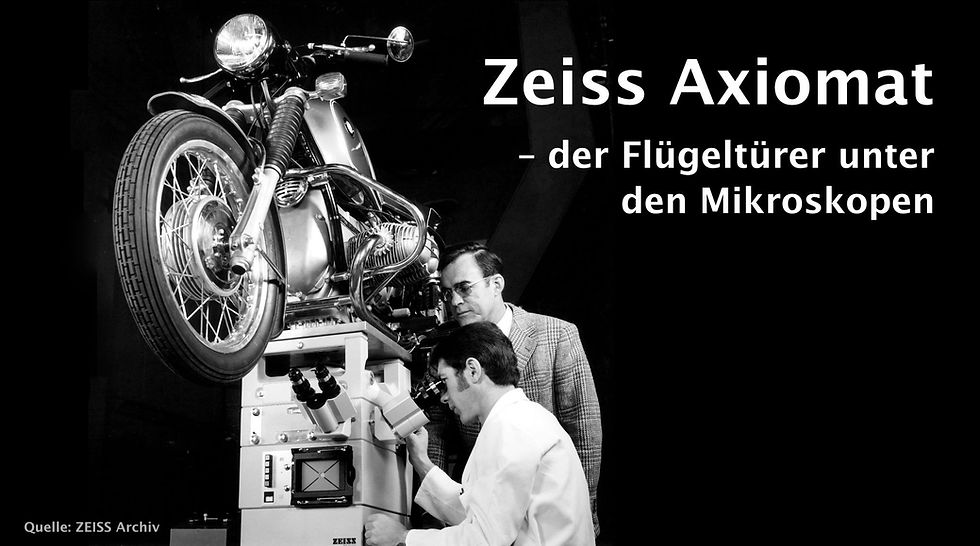
Forgive the analogy, but to me the Axiomat is the gullwing among microscopes. I am referring to the Mercedes-Benz 300 SL of the 1950s, that legendary sports car with its upward-opening doors, which to this day looks less like an ordinary automobile than a technical apparition. Not because the Axiomat is slender, nimble, or easily integrated into everyday life. Rather, because it comes from the same kind of engineering culture—a culture in which construction was still allowed to display character. What the gullwing doors were to the 300 SL, the Axiomat’s entire blocklike form is to the microscope: the visible consequence of a technical idea that was never cut down to the dimensions of convenience. The Axiomat is not a friendly instrument. It is a declaration.
Its angular appearance also reminds me strikingly of an architectural movement that left some of its strongest marks during precisely that period: Brutalism. This was the architectural style that shaped many public buildings, especially during the 1960s and 1970s—schools, universities, city halls, churches, and cultural centers. Large, heavy structures of exposed concrete: cool, angular, unclad, their construction openly displayed, with a peculiar mixture of severity, solemnity, and naked honesty. These buildings did not seek to please like a pretty bourgeois townhouse. They showed what they were made of. They did not conceal their mass; they turned it into an expression.
The Axiomat, too, breathes something of this spirit. Material is available, so it is used. Mass is not concealed, but accepted. Function is not disguised, but made visible as construction. The instrument does not ingratiate itself with the eye. It simply stands there: heavy, angular, modular, uncompromising. In this respect as well, it is a child of its time.
In 1972, one year before the Axiomat entered the market, the Club of Rome published The Limits to Growth, which, for the first time with major public impact, warned of the consequences of increasing resource consumption and growing environmental damage. But insights of that kind do not transform overnight the forms in which technology is conceived, built, and purchased. The Axiomat still looks like a machine from the age before that realization—from a world in which precision was allowed to occupy space, stability was allowed to have weight, and no one seemed to feel guilty when an optical idea placed a roughly one-hundred-kilogram colossus of metal and glass on a laboratory bench.

The Axis as a Worldview
Even the name does not sound like that of an ordinary microscope. “Axiomat”—this is not a pretty word coined by a marketing department, not an appealing model name suggesting lightness, elegance, or ease of use. It contains the axis, the central line around which everything is arranged. And it also echoes the word axiom, that principle in mathematics and logic that no longer needs to be proved, but is simply taken as given. That is exactly how this microscope presents itself. It does not ask whether the traditional form of the microscope might perhaps be sufficient after all. It establishes a new order and then builds everything around it.
Whether Zeiss intended this double meaning in any literary sense is almost beside the point; the instrument itself behaves as though it did. It places an optical axis at the center and builds a world around it.
In conventional microscopes, the stand is the dominant element: base, column, stage, tube, eyepieces. The family resemblance to the instrument that had occupied laboratory benches in ever-new variations since the nineteenth century is immediately recognizable. In the Axiomat, that lineage is only faintly visible. It does not look like a microscope that has simply grown larger. It looks like a microscope that decided to become its own architecture.
The central optical axis runs vertically through the middle of the system. Modules are arranged, added, rotated, and combined around it. The traditional microscope stand is not merely improved; it is, in a sense, dismantled and rebuilt. No longer: “Here is a stand to which accessories can be attached as needed.” Instead: “Here is an optomechanical system in which accessories, techniques, illumination, observation, and documentation have all been considered from the outset.”
That is the instrument’s real ambition. The Axiomat did not merely want to be an especially large, especially heavy, or especially expensive microscope. It wanted to embody a new order of microscopy. A modular system, but not in the harmless sense of a child’s construction set. More in the sense of technical urban planning: axes, levels, passageways, connections, functional spaces. One does not simply attach something. One configures an installation.
Even the controls reflect that ambition. The Axiomat has motorized focusing, operated not with the familiar fine-focus knob of a conventional microscope, but with a joystick. That alone changes one’s posture toward the machine. One no longer turns a crank on an instrument; one controls a system. There is also an optical zoom system that allows the microscopic image to be enlarged continuously by up to 3.2 times. This, too, is typical Axiomat: instead of changing objectives or extending the tube, the image is given another range of adjustment within the system itself.

This is also the source of its peculiar impoliteness. The Axiomat is not hostile to the user. It is simply entirely unimpressed by the user’s existence. The Axiomat does not begin by asking how comfortably a person can sit in front of it. It asks how many microscopy techniques can be forced into a single shared system. Transmitted light, reflected light, brightfield, darkfield, phase contrast, interference contrast, polarization, fluorescence, photography, television camera, upright and inverted configuration—the machine looks as though someone at Zeiss had compiled a list of every serious light-microscopy requirement imaginable at the time and said, “Yes.”
Not: “Yes, but perhaps a little smaller.”
Not: “Yes, but please make it more user-friendly.”
Simply: “Yes.”
The result is a microscope that feels more like a manifesto than a product. Its size is not incidental, but a consequence of its idea. Its mass is not a whim, but a prerequisite. Its modules are not decoration, but the visible building blocks of a technical worldview: If microscopy has become complex, the instrument should not conceal that complexity. It should carry it.
That is what makes the Axiomat so fascinating today. It comes from a time when advanced technology did not yet pretend to be simple. Modern instruments usually try to make their internal complexity disappear behind smooth plastic housings, displays, software menus, and ergonomically shaped surfaces. The Axiomat does the opposite. It puts its demands on display. It does not conceal that precision requires space, that stability demands weight, and that versatility cannot exist without mechanical consequences.
Seventeen Volkswagen Golfs—or One Optical Path
This attitude came at a price. And not a symbolic one.
A Zeiss Axiomat NDC in its standard configuration cost around DM 135,000 in the mid-1970s. One has to let that number stand for a moment, or it loses its force: DM 135,000! This was not the price range of an expensive laboratory instrument that could simply be ordered after some hesitation. It was an amount for which an institute had to plan, justify the expense, release funds, and set priorities. An Axiomat was not purchased casually. It had to be wanted—and financed. My own Axiomat, which came from a university, still bears a small label reading: “Purchased with funds from the Volkswagen Foundation.”
The scale of that sum becomes clear only when it is taken out of the laboratory. A new Volkswagen Golf in its most basic configuration cost exactly DM 7,995 in 1974. For the price of a suitably equipped Axiomat system, one could therefore have purchased approximately seventeen brand-new Golfs. Not shabby used cars, not rusty institute runabouts with a coffee stain on the passenger seat, but new cars—a small motorcade. (Should you decide to do the math: exactly DM 915 would still be missing. But Volkswagen would surely have offered a volume discount.)

And even that comparison is still too small, because DM 135,000 was also roughly equivalent at the time to the basic construction cost of a small single-family home. Not a villa, not a park-like property, not a marble bathroom with gold faucets. But still: walls, roof, windows, heating, doors—a home for a family.
This makes it clear who could even be considered a customer for such a microscope. Certainly not private individuals, unless they possessed both a pronounced passion for microscopy and an oil well. Small medical clinics, hardly. Ordinary hospitals, probably only in exceptional cases. The Axiomat belonged in major universities, research institutes, industrial development laboratories, and perhaps central facilities where several research groups could share access to a common system.
Only there did its modularity truly make sense. An Axiomat was not an instrument purchased for the occasional examination of a microscope slide. It was an infrastructure. It could be expanded with modules, rebuilt, adapted, converted from an upright to an inverted system, configured for biological or technical applications, fitted with cameras, connected to television equipment, and used for photographic documentation, measurements, and specialized techniques. Anyone who acquired such a machine was not merely buying microscopy. They were buying the claim of being prepared for almost anything.
That probably also explains reports from universities where such a system did not simply stand in a laboratory, but was placed under someone’s care. There were institutions in which an employee was responsible for photomicrography, photographed specimens, operated the cameras, and made sure that the optical installation produced reliable images. The Axiomat was not a microscope one understood on the side. It was the kind of apparatus that needed its own technician.
And perhaps this is precisely the decisive difference from today’s instruments. Modern microscopes often pretend that nobody needs to know what is happening inside them anymore. The Axiomat did the opposite. Through its price, its mass, and its construction alone, it made clear that research was not conceived as a pleasant desk activity, but as an institutional feat of strength. Anyone who bought one was not merely placing a machine in the laboratory. They were erecting a declaration.
A Rare Species of Metal and Mechanics
Seen in this light, it is hardly surprising that the Axiomat was never a mass-produced instrument. Production began in 1973; by the mid-1980s, its actual era had come to an end. In 1986, Zeiss introduced the next generation with the Axioplan and Axiophot, carrying the principle of infinity optics forward in a more manageable, ergonomic, and production-oriented form. Individual Axiomat components and accessories may have remained in catalogs and warehouses for longer; references extend as far as 1989. But as a living product idea, the Axiomat belongs to the period from 1973 to the mid-1980s.
Exact production figures have not been published, as far as I have been able to determine. The number most commonly mentioned is around 640 instruments, while one source gives a figure of slightly more than 700. Mine bears the number 462. Even this uncertainty seems appropriate for an instrument that never belonged to the world of large production runs. The Axiomat was not a microscope that rolled out of the factory gates in droves.

In Germany, approximately 80 to 100 Axiomat systems were probably sold, mainly to universities and major research institutions. The overwhelming majority were installed as upright microscopes. Inverted systems were considerably rarer. For those, the modular body of the Axiomat was, in a sense, turned upside down: The three main modules were rotated together by 180 degrees, transforming the upright research building into an inverted one. Perhaps 20 to 25 such systems were sold in Germany. The numbers become smaller still when one asks about inverted Axiomats equipped for polarization. At that point, we are probably no longer speaking of dozens, but of five to ten instruments—one of which, by a fortunate coincidence, now stands in my office.
These figures are worth pausing over. Many old microscopes are rare simply because they are old. The Axiomat was rare when it was new. From the very beginning, it was not an instrument for many, but for a few: a few institutions, a few budgets, and a few people capable of presenting sufficiently persuasive arguments to the appropriate funding departments. Only a handful of these instruments, now half a century old, are in private hands today. Many of the others, if they have survived, probably remain in universities, research institutes, or collections devoted to the history of science, or are displayed in museums—for example, in the Museum of Medical History at the University Medical Center Hamburg-Eppendorf.
The Microscope with a Chassis Number
And because such a system was not only expensive, but modular, Zeiss apparently had to consider something else as well: the identity of the instrument, and ultimately also theft and illegal resale. An Axiomat did not consist of a single housing that could be recognized as a whole like an ordinary microscope. It consisted of blocks. Observation module, illumination module, camera module, intermediate components, extensions—an optical structure composed of separate elements that appeared interchangeable. What belonged together therefore had to remain recognizable as belonging together.

For this purpose, the modules assembled at the factory into one Axiomat system were given a common number. To continue the gullwing analogy, one might call it a chassis number. Except that it is not proudly displayed on a nameplate. It is hidden in the front-left screw opening, deep inside the metal, in a place one would not normally inspect because one would not expect to find anything there.
Only when the modules are separated and one deliberately looks into this opening does the number appear: not printed, not painted, not attached on a label, but burned directly into the metal surface. Under magnification, one does not see uniform lines, but a sequence of small dark dots, craters, and discolored edges.
This is very much in keeping with the Axiomat. Even its identity is not displayed conveniently on the surface, but buried deep in the material, mechanically awkward to reach, and surprisingly well protected against casual grinding away or tampering. The marking cannot prevent someone from carrying off a module. But it makes the module much harder to make disappear without a trace.
At the same time, the number tells us something else. It shows the category in which this microscope operated. An Axiomat was not an anonymous serial product that came off an assembly line in large quantities and was merely packed afterward. Even accessories such as objective carriers or functional inserts for polarizers and other equipment bear stickers with the same system number.
This shows that Zeiss did not regard the Axiomat merely as a collection of interchangeable individual parts, but as a coherent system with an identity and provenance of its own. It was an instrument whose identity extended all the way into its screw openings.

The Engine Room
Viewed from the outside, the Axiomat initially presents itself as a collection of blocks. Large, angular modules stacked together into a system. That almost sounds simple. Module is a word from the friendly world of construction kits. One takes one piece, adds another, and the instrument can suddenly do more.
With the Axiomat, however, that idea is about as naive as assuming that a railroad station consists mainly of tracks. Remove the cover plate from one of these modules, and what appears is no longer an accessory, but an optical engine room. Prisms, mirrors, lenses, gears, sliders, detents, shafts, and rotating disks are packed together so tightly that it looks as though someone had tried to fit a small switching yard for light inside a metal housing. The central beam of light does not simply enter somewhere and exit somewhere else. It is deliberately guided, split, redirected, bundled, sent through optical elements, transferred to other axes, and routed toward different outputs. Behind the gray surface begins a nested system of optical decisions.

This is where it becomes clear why the Axiomat is not simply an ordinary microscope with a great deal of equipment attached to it. Its complexity is not on the outside; it is inside. In many microscopes, extensions are visibly attached to the stand: a phototube here, an intermediate tube there, an attachment, a slider, an adapter. In the Axiomat, extension becomes architecture. The optical paths run through modules, and those modules already contain the mechanisms required to switch light paths, introduce different techniques, and connect observation, photography, or television imaging.
That sounds dry. In reality, it is rather uncanny, because what one sees inside the open module is not only technical sophistication, but also a way of thinking. Light is not treated here as something that obediently travels from bottom to top through a microscope. Light is material. It is routed like traffic. It is given switches, intersections, detours, and exits. There are main lines and branch lines, observation routes and documentation routes, optical junctions and mechanical control centers. Anyone who designs in this way is no longer thinking in terms of the shape of a microscope stand. They are thinking in optical paths.
Inside such a module, the Axiomat becomes almost literally what its name promises: an instrument of axes. Not one axis, not one tube, not one fixed path from objective to eyepiece, but an ordered system of light paths that cross, separate, and reconnect inside. One might say: Other microscopes show an image. The Axiomat manages the route by which that image is allowed to come into being at all.

The Stage Machinery
Anyone who does not merely send light straight through an instrument, but redirects, distributes, splits off, and documents it, needs space. This explains why the machine is so large, so heavy, and so unwilling to compromise. Its mass is not merely ostentatious overengineering. It is the price of an optical infrastructure that must remain mechanically precise. If prisms and lenses are moved on rotating disks or sliders, if outputs are switched, optical paths held stable, and cameras integrated into the system, none of this can be packed into a thin sheet-metal or plastic housing that gives way in offense at the first forceful touch. The Axiomat needs its boxes, wall thicknesses, bearings, and gears.
It needs this housing in the same way that a theater needs stage machinery. From the front, one sees the performance. Inside, one sees the machinery. And perhaps this is precisely where part of its fascination lies. From the outside, the Axiomat conceals almost everything. It displays mass, edges, openings, and connections—but not what is actually happening inside its modules. Only when opened does it reveal everything, and then it becomes almost more beautiful still.
When the observation module is opened, one suddenly realizes that these gray blocks are not dead mass, but containers for optical movement. The image is not managed by software and not selected from a menu. Here, metal, glass, gears, detents, prisms, and sliders are at work. Light is mechanically guided, split off, redirected, and delivered to the places where it is needed.

Other modules tell other chapters of the same story. In the camera module, electronics, circuit boards, cables, and transistors are added; there, the optical structure also becomes a photographic apparatus of the 1970s. But it is precisely this mixture that makes the Axiomat so distinctive. It is not simply mechanics, not simply optics, not simply electronics. It is an entire technological era in modular form.
It is anachronistic.
And magnificent.
From Box to Principle
This idea did not emerge entirely out of nowhere. Even before the Axiomat, Zeiss had built instruments in which the traditional microscope stand could be recognized only with some generosity. The clearest example is the “IM,” a biological inverted microscope using conventional finite-conjugate objectives, whose outward appearance already resembled a technical apparatus more than a laboratory instrument. No elegant base, no familiar column, no tube rising obediently above the stage. Instead, there was a heavy box, inside which prisms, lenses, and mechanical deflections directed the light beam wherever it was needed. Years later, it was expanded to include 35 mm and large-format cameras, becoming the “ICM 35” and “ICM 405,” respectively.

These inverted microscopes look as though someone at Zeiss had one day decided that the external form of a microscope was not sacred. If the optical task was complex enough, then the instrument was allowed to look like a box. Or like a safe containing not money, but optical paths.
The Axiomat did not simply adopt this construction. But it radicalized the same act of disobedience: If the optical path requires a different form, then the housing must yield to the idea, not the other way around.
This marks the beginning of a small revolution that is easy to miss because it does not announce itself loudly. The microscope ceases to be primarily a stand. It becomes a housing for optical paths. Not everything that happens remains visible from the outside. The path of the light disappears into the interior. It is redirected, divided, carried onward, and used photographically. The user sees knobs and openings at the front. Inside, however, a mechanism operates that resembles railway signal-box engineering more than the simple route from objective to eyepiece.
The IM was still a specialist. The Axiomat wanted to be a system. It was an attempt to turn the box into a principle.
This is also where the introduction of the infinity-corrected objective system becomes important. In traditional finite systems, the optical path is more tightly bound to a fixed mechanical tube length. Put simply, the microscope is an optical route of defined length. In an infinity system, the light initially leaves the objective as an approximately parallel bundle and is formed into an image only later by a tube lens. Space is created in between.
And space is exactly what the Axiomat needs, because optical components can be inserted into that space without every additional element ruining the entire system. Filters, prisms, intermediate modules, camera branches, observation paths, reflected-light and transmitted-light components: They all find room in an optical path that no longer has the delicate simplicity of a traditional finite microscope, but the spaciousness of a complex installation.

That sounds like optics. But in truth, it also sounds like architecture. A conventional microscope is a staircase: specimen below, eye above. The Axiomat is a building with corridors, shafts, branches, utility rooms, and emergency exits for photons. Light does not simply travel upward. It is administered. It is assigned routes, responsibilities, deflections, and connection points. And somewhere within this mechanical bureaucracy, an image actually emerges.
This is magnificent. And slightly insane. Magnificent because Zeiss conceived microscopy here not as a sequence of individual accessories, but as an integrated system. Insane because that idea was translated into metal, glass, and mechanics as though nobody in the room had dared ask whether it might also be possible to make the whole thing one size smaller.
But that very excess is what makes the Axiomat interesting. It is not an instrument of minor improvement. It is not a new model with a slightly better focusing mechanism, a slightly larger field of view, and a slightly more convenient phototube. It is a fundamental decision. A microscope that asks: What happens if one begins not with the person at the eyepieces, but with the optical path?
The answer stands before you.
Very heavy. Very expensive. Very Zeiss.
The Untamed Future
And then there is that small word that would later shape an entire family of Zeiss microscopes: Axio.
Axiomat. Axioplan. Axiophot. Axiotron. Later Axiolab, Axioskop, Axio Imager, Axio Observer. There is no need to turn this into linguistic mysticism, but the continuity of the names hardly seems entirely accidental. Something remained: the axis, the order, the new optical principle. The Axiomat was not merely an especially eccentric side road after which Zeiss returned to business as usual. It looks more like a massive anticipation of what was to come—an instrument that still had to solve with the mechanics of the 1970s many things that later microscopes would implement more smoothly, compactly, conveniently, and as part of regular production.

Perhaps that is the real tragedy of the Axiomat: It was not merely large. It was also early.
It already embodied a new system logic, but in a form that looked as though the future had to be delivered by forklift. Infinity optics, modular organization, the multitude of techniques, the integration of photography and television technology, the idea of the microscope as a platform—all of this points forward. But the execution comes from an era in which complexity was not miniaturized, but built. Solidly. Heavily. Visibly. With screws, gears, detents, prisms, sliders, and housings that never asked whether the table was truly grateful for the burden.
Later Zeiss microscopes appear beside it almost like civilized descendants of a somewhat intimidating ancestor. They inherit the basic ideas, but behave better. They stand on the laboratory bench without forcing it into submission. They no longer lead the user through an optomechanical industrial installation, but through a better-designed interface. They are more ergonomic, smoother, more systematic, and better suited to regular production.
The Axiomat, by contrast, captures the moment before the idea was tamed. That is what makes it so unique. It is not a museum piece simply because it is old. There are many old microscopes. The Axiomat is a museum piece because it embodies a technological transitional form: between the traditional research stand and modern system microscopy, between simple mechanics and the platform concept, between laboratory instrument and optical structure. It stands at a point in development when Zeiss apparently did not ask, “How can we make a microscope slightly better?” but instead, “What if we rethink the microscope from the ground up?”
The answer was not elegant.
But it was impressive.
The Image Factory
The Axiomat was not built merely for seeing. It was built for recording what was seen. That clearly distinguishes it from many older microscopes, in which photography often seems like a desire grafted on afterward. Of course, microscopy had been photographed before. Cameras could be mounted, tubes extended, adapters attached, focusing screens examined, exposures tested—and in the process one might occasionally begin to feel less like a microscopist than a plumber of optical paths. In the Axiomat, by contrast, documentation is part of the system concept. The image was not meant to exist only in the eye. It was meant to reach film, Polaroid, the screen, perhaps even another room.
This is an important point. The Axiomat belongs to an era in which the microscopic image was no longer merely a personal observation, but became material: for publications, lectures, teaching, diagnostics, research, and archiving. What was seen had to be shown. And what was to be shown had to come out of the instrument—not somehow, not through an adventurous improvised solution, but along a path designed for that purpose.
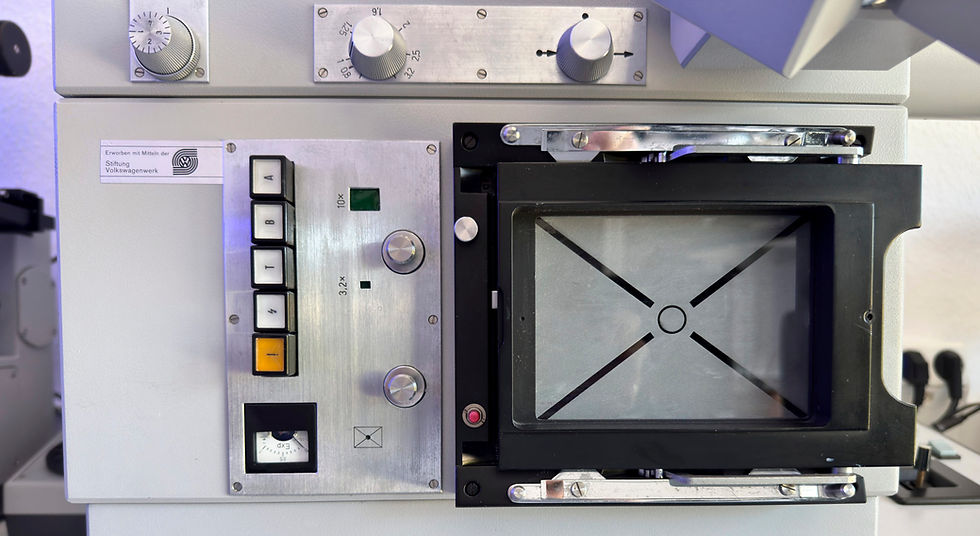
Here again, the Axiomat does not think modestly. It does not merely offer a phototube as a small, polite bow to the camera. It has dedicated camera chambers, ports, and optical paths. The instrument seems to say: If an image is produced, it must not remain trapped inside the observer’s head. It must be documented, checked, and passed on—the microscope becomes an image factory.
A very small image factory compared with a printing plant.
But a very large one compared with an ordinary microscope.
The built-in large-format camera for Polaroids seems almost touching today. One has to remember what it meant: a quick test image, an immediate look at exposure, framing, contrast, focus, and depth of field. There was, of course, a focusing screen on which the image could be checked in advance. But it was not a display in the modern sense—no luminous live view, no histogram, no electronic viewfinder, no “just zoom in and check.” What appeared on the focusing screen was more like an intimation of the image: large enough to assess the setup, but too indistinct to remove the uncertainty entirely. So there was still the Polaroid: chemistry, patience, material costs, and that small ritual in which an image did not simply appear, but visibly developed. Beside it was the 35 mm camera for the actual documentation: negatives or slides, more suitable for archiving and publication, but slower and more final.
And then there was the output for a television camera or video transmission. That, too, belongs to the ambition of this instrument. The Axiomat no longer sits alone on the laboratory bench, observer and specimen locked in private intimacy. It sends its image to a monitor. Into another room. Into a lecture hall. Into a technical environment in which microscopy is not merely observation, but communication.
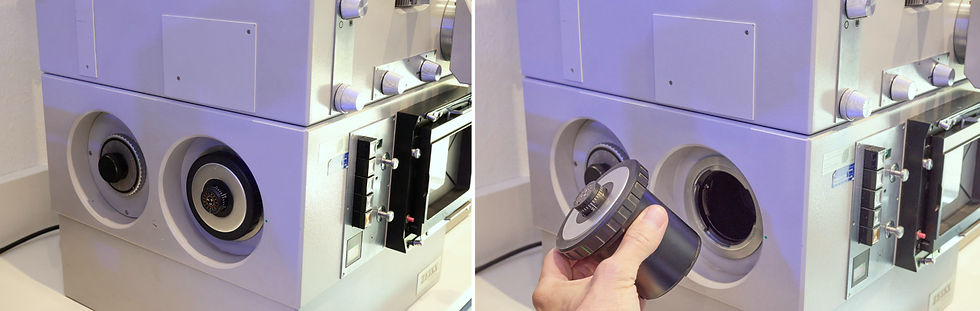
This is, in a sense, the social dimension of the instrument. The Axiomat belongs to an era in which science was becoming concentrated into large institutions, major research facilities, large-scale apparatuses, and grand promises. Research became more specialized, more documentation-driven, and more demonstrable. The microscopic image was no longer merely a personal finding at the eyepiece, but material for shared work: for verification, teaching, archiving, and publication. The Axiomat was built precisely for that.
A small field microscope in a wooden box tells of a private closeness to nature.
The Axiomat tells of science’s administered visibility.
When Construction Acquires Character
In the end, then, the audacious automotive analogy from the beginning does indeed lead back to the core of the matter. It was never about calling the Axiomat elegant. The comparison works for a different reason: Like that famous sports car, the Axiomat comes from an engineering culture in which construction was still allowed to display a visible attitude. Not as a friendly offer, not as an ergonomically smoothed promise, not as a product intended to offer as little resistance as possible. But as a decision.

Things like this are rare. And they usually do not arise out of modesty. They arise when engineers, designers, opticians, mechanics, and decision-makers apparently believe, for a moment, that an idea does not have to be scaled down simply because it is large. That a problem is not made more elegant by concealing its consequences.
That is why the Axiomat is not merely an old Zeiss microscope. It is a document. A document made of metal, glass, prisms, gears, modules, camera chambers, and a great deal of self-confidence. It tells of a time when scientific instruments could still be conceived as institutional structures.
Today that feels foreign. Perhaps even absurd. A modern microscope would apologize for much that the Axiomat assumes with stoic calm: its size, its weight, its complexity, its inconvenience, its need for space, its refusal to ingratiate itself with the user. But that is precisely what makes it so fascinating. It is not charming in the usual sense. It is not pleasing. It is not even especially polite. It demands respect.
And when you sit in front of it, you understand that some instruments are more than the sum of their functions. They show not only what was technically possible. They show how an era thought about technology. The Axiomat shows an era that took the optical path more seriously than the familiar form of the microscope stand.

Reasonable cars have doors that open to the side, so that one can get in effortlessly and comfortably. Some idiosyncratic cars are unforgettable precisely because they did not: the BMW Z1, because its doors disappeared downward into the sills; the 300 SL, because its doors rose upward. Both required their occupants to rehearse a small choreography involving hips, knees, and dignity before getting in. But in both cases, those doors were not merely a whim of design. They were the visible consequence of a high side sill that obstructed easy entry and therefore required a different door concept. So the doors had to open upward—or downward, respectively.
Technology took precedence. And that is exactly where the kinship to the Axiomat lies. It does not seem idiosyncratic because someone at Zeiss had a bad day and an excess of aluminum. It seems idiosyncratic because its inner order is idiosyncratic. The axis, the modules, the optical paths, the camera chambers, the mechanical switching, the entire optical infrastructure—all of this demands space, mass, stability, housings. What looks like exaggeration from the outside is, on the inside, consequence.

So the Axiomat is not the gullwing of microscopes because it is beautiful. It is because, like that sports car, it shows what happens when a technical idea is not trimmed down to the dimensions of convenience. In the 300 SL, a structural necessity became an icon. In the Axiomat, an optical axis became a monumental research building of metal and glass. Not beautiful in any ingratiating sense. But possessed of a cool, almost defiant honesty.
Daniel Knop, www.knop.de

Kommentare