A Mosquito’s Head and the Republic
A Travel Microscope Owned by Dr. Hermann Luppe – Between Bourgeois Natural History and Weimar Democracy

Inside the wooden box lies a small brass microscope. Not a large research instrument, not a Zeiss stand, not a Leitz Orthoplan, not a heavy Axiomat with the aura of industrial precision. This microscope is smaller, simpler, more intimate. It consists of nested brass cylinders, a mirror, a simple slot for the slide, and several optical inserts.
The box cover carries a French label: “Grossissement.” Magnification. The first line of the small table reads: “1 lentille … 30 fois” – one lens, thirtyfold. At first, it takes no more than that to turn a piece of glass into an instrument of wonder.
Yet the truly remarkable thing about this small instrument is not its construction. It is a note. A brittle piece of paper, typed with the words: “Dr. Herm. Luppe, Bürgermeister, Frankfurt a. M.” (Dr. Herm. Luppe, Mayor, Frankfurt am Main.; “Herm.” is the abbreviated form of Hermann). With that, the travel microscope suddenly leads out of the private world of natural observation and into the political history of Germany: to a liberal municipal politician, a co-founder of the German Democratic Party in Frankfurt, a member of the Weimar National Assembly, later mayor of Nuremberg – and to a man who came into conflict with the Nazis early on.
But for the moment, there is only this small instrument in its wooden box. And that is precisely part of its appeal: it tells its story quietly, by way of detours.
The word “Grossissement” already tells us something. The instrument very likely comes from a French or French-speaking context. It belongs to that family of small drum or travel microscopes that were widespread in the nineteenth century: compact, collapsible, portable, suitable for the desk, for travel, for teaching, for private observation of nature. Not a machine for major research, but an instrument for looking into a small world.

One of the slides is especially touching. It is not simply made of glass, but framed with ornamentally printed paper. In the center sits a tiny mosquito’s head. Next to it, handwritten in a German script close to Kurrent, is the word: “Mückenkopf” – mosquito head. The specimen seems older than the political trace that makes the microscope so interesting to me today. Stylistically, it still belongs to the world of the late nineteenth century, to that bourgeois culture of prepared specimens in which insect wings, plant hairs, stamens, and tiny animal bodies became objects of observation.
Such specimens tell of a time when microscopy was not only a matter for universities. It was also part of a culture of education. People wanted to see what remained hidden from the naked eye. Not necessarily in order to make a scientific discovery, but to take fuller possession of the world by looking more closely. The mosquito’s head on this slide is tiny, but it is not a random remnant. It is a promise: Place me under the microscope, and I will show you that even the inconspicuous possesses a complex order.
The fact that instruments like this found their way into living rooms, studies, and classrooms was no coincidence. The nineteenth century was also the century in which looking into the small became one of the great movements of discovery. The microscope grew beyond the world of simple lens systems and developed into a scientific precision instrument. In Jena, Carl Zeiss, Ernst Abbe, and later Otto Schott worked to push its optical limits. What lens makers had previously improved through trial and error, through the old practice known as „Pröbeln“, now became increasingly calculable. Thanks to Abbe, objectives were designed on a physical basis; new types of glass opened up new possibilities for correction. In 1886, Zeiss introduced apochromatic objectives and matching compensating eyepieces – a step that showed how far chromatic aberration and blur could be reduced. While small travel microscopes like this one still embodied the older, handy world of private natural history, workshops and laboratories were producing instruments with which medicine and biology would transform their own foundations.
A small episode from Charles Darwin’s circle shows how far the reputation of these instruments reached: in 1881, Darwin asked Ernst Haeckel to order a microscope from Carl Zeiss in Jena; Ernst Abbe selected the lenses.
At that time, looking into the small was more than a pastime. It became one of the great movements of knowledge of the century. Researchers such as Rudolf Virchow, Louis Pasteur, and Robert Koch made visible the fact that disease, life, and tissue had to be understood on a level inaccessible to the naked eye. Cells, bacteria, tissue structures, pathogens: the microscope did not simply open up a charming miniature world, but a new reality. There is, of course, a great distance between the mosquito’s head of a private demonstration slide and the major discoveries of medicine. But both belong to the same historical movement: the urge not merely to look at the world, but to understand it more precisely.

But the small slip of paper, too, deserves a closer look. Not because it says a great deal, but because its terse wording ties the microscope to a particular phase in Luppe’s life: his Frankfurt years, before he moved to Nuremberg in 1920. It does not turn the travel microscope into a political object, but it does give it a political trace. It acquires an address, a biography, a historical shadow.
Hermann Luppe was not a natural scientist, but a lawyer, an administrator, and a liberal politician. In Frankfurt am Main, he had been a member of the city council since 1909; in 1913, he was elected Second Mayor. In 1918, Luppe was among the co-founders of the German Democratic Party in Frankfurt, that left-liberal force which counted among the most determined supporters of the young Weimar Republic. In 1919/20, he was a member of the Weimar National Assembly. This was not just any parliament. It was the parliament that, after war, revolution, and the collapse of the monarchy, was meant to lay the constitutional foundation for Germany’s first parliamentary democracy.
The small note does not securely date the microscope itself. The instrument is probably older, perhaps dating from around 1880 or 1890. The slide with the mosquito’s head, too, seems more like a piece from the natural-history culture of the late nineteenth century. But the note dates the context of ownership or storage.
With that, the small microscope suddenly touches a larger story. Luppe was one of those municipal politicians who defended the Weimar Republic not only in speeches, but tried to shape it practically in the cities: through administration, social policy, housing, public institutions, municipal modernization. The Republic did not consist only of cabinet crises, Reichstag elections, and street battles. It also consisted of offices, budgets, schools, hospitals, housing, welfare, streetcars, public outdoor pools. In other words, of work that rarely looks heroic, but that makes a democratic order inhabitable in the first place.
In Nuremberg, Luppe soon found himself in conflict with the Nazis. Julius Streicher in particular, publisher of the antisemitic hate sheet „Der Stürmer“, turned him into a target. The confrontation was not merely a personal feud. It revealed how the Nazi movement operated during the years of the Weimar Republic: it occupied public space, turned political opponents into enemies, replaced argument with agitation, and made municipal politics into a battlefield. Luppe stood for a liberal, republican culture of public administration; the Nazis stood for its destruction.

In 1933, after the Nazis came to power, Luppe was arrested, forced out of office, and eventually compelled to leave Nuremberg – the city that would soon become one of the most important stages for Nazi spectacle and self-presentation. He did not go underground, but neither did he simply disappear into private life. In Berlin, and later in Kiel, he remained connected to scattered democratic and conservative opposition circles that could scarcely act openly under a dictatorship. He was arrested several more times; to the end, his name remained associated with the democratic republic the Nazis had sought to humiliate and destroy.
The microscope itself, of course, says nothing about any of this. It is not a political instrument. It heard no speech, witnessed no vote, recorded no city council meeting. Perhaps it lay in a drawer, probably in Hermann Luppe’s office; perhaps it had not been used for a long time. But precisely there lies its fascination. It is not a monument. It is a remnant.
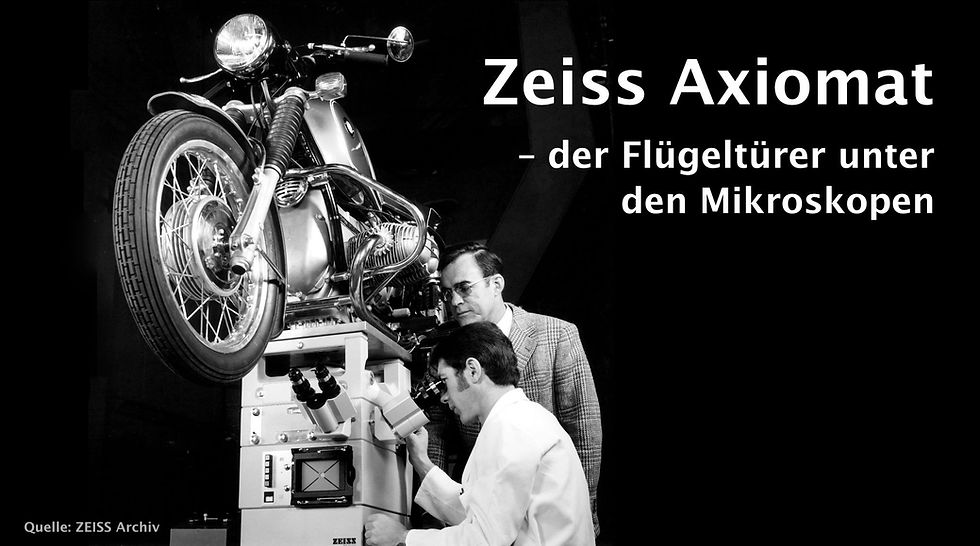
Today, it belongs to my small private collection of microscopes. It stands in line with very different instruments: with large research microscopes, with devices that embody precision, standardization, and industrial capability. Next to my Zeiss Axiomat, this French travel microscope seems almost fragile. There, the monumental research machine of the twentieth century; here, a small brass tube from an older culture of education. And yet both are joined by the same basic impulse: to look more closely.

The mosquito’s head is more than a specimen. It is the smallest point at which the history of this object gathers. A tiny fragment of an insect, a French label, German handwriting, a wooden box, a note of ownership, a liberal politician, the Weimar Republic, the rise of National Socialism. None of these things fully explains the others. But together they form a small, peculiar layering of time.
Perhaps that is the real appeal of historical microscopes. They do not only show something under the lens. They are specimens themselves. One can look at them like a section through vanished worlds: technological history, educational history, ownership history, and sometimes political history as well. This small brass instrument no longer magnifies a mosquito’s head today, at least not in my everyday life. But it magnifies something else: my view of a time in which private curiosity, bourgeois education, and democratic responsibility could still belong to the same life – and of another time, which soon afterward began to destroy precisely that world.
Daniel Knop, www.knop.de

Kommentare