Iris Photography with Focus Stacking
- Daniel Knop
- 8. Jan.
- 24 Min. Lesezeit

Iris photography is currently experiencing a real boom. That has a lot to do with its visual appeal – but even more with a simple realization: the human iris is astonishingly individual. No two irises are alike. Colors, structures, lines, and speckles are as unique as a fingerprint. And the closer you look, the more a complex landscape emerges – one that is barely perceptible to the naked eye.
Anyone who tries to make this world visible with a camera quickly discovers a problem: as fascinating as the iris may be, it is also remarkably uncooperative. Especially at high magnifications, for example when the goal is large-format prints, technical limits appear very quickly. The biggest issue is depth of field – or, more precisely, its near-total absence.
The iris is rarely perfectly parallel to the camera’s sensor plane. Even the slightest tilt of the eye, something that is almost impossible to control, causes parts of the iris to fall out of focus immediately. What hardly matters in normal portrait photography becomes a serious obstacle at high magnifications: the required depth of field increases dramatically, while the depth of field actually available becomes smaller and smaller the closer the front lens moves toward the eye.
Of course, the obvious idea is to simply stop the lens down further. Unfortunately, that only helps to a limited extent. Small apertures inevitably introduce diffraction blur – and that destroys exactly what iris photography is all about: fine structures and maximum detail. In practice, this often leaves only one option: take lots of pictures and hope that a few of them really stand out. Fifty, seventy, or even more images per eye are not uncommon – and most of them end up in the trash.

At this point, an obvious question arose to me: why not use focus stacking? In macro and micro photography, this technique has been well established for years whenever extreme depth-of-field problems need to be solved. Why should it fail precisely in iris photography?
A targeted online search was initially sobering. Everywhere I looked, I encountered the same statement: focus stacking is not practical for iris photography – or simply impossible. Most of the time, that claim is left unexplained.
To get straight to the point: the situation is not quite that clear-cut. Thanks to recent developments in camera technology, it has become possible under ideal conditions to further increase sharpness and detail in iris photographs using focus stacking. This is largely uncharted territory and apparently still little known – and that is exactly what the final part of this article is about.
Before getting there, however, I would like to outline my general approach to iris photography. This is explicitly not meant to be a universal guide. Many iris photographers have developed their own styles and methods. The focus here is on practical implementation: how the images are created. Post-processing will only be touched on briefly.
The Environment
For iris photography, one thing matters above all else: control over light. And this is where the trouble begins. The human eye is best imagined as a small, highly polished sphere. That sphere mercilessly reflects everything around it – ceiling lights, windows, even bright areas of your own hand. And the direction of the light hardly matters: the eye seems to “see” the entire room at once.

In theory, there is a radical but effective solution to avoid these unwanted reflections: darken the entire room, turn off all light sources, and eliminate as many bright surfaces as possible. Many iris photographers work exactly this way – and it works.
I chose a slightly different approach. Instead of controlling the entire room, I focused on controlling the immediate surroundings of the shot. To do this, I built a box that largely shields the eye from its environment during the exposure. The head is placed inside the box, the chin rests on a support, and the forehead leans against the top. This stabilizes the head along at least two axes – an advantage that should not be underestimated at high magnifications.
To prevent reflections inside the box itself, the entire interior is lined with thin black felt. Bright surfaces simply do not exist anymore. In hindsight, the construction could easily be improved: a bit more width, a bit more height, and above all adjustable chin and forehead rests would significantly increase flexibility. The box was built rather spontaneously for an iris photography workshop. It does its job – but as so often, once the build is finished, the optimization begins.

Shooting Technique
What kind of gear do you actually need for iris photography? In this article, I consistently assume that the images are meant to be printed large – as wall art, not as Instagram thumbnails. That immediately rules out smartphones.
This does not mean that smartphones are fundamentally unsuitable. With dedicated macro optics and high-resolution sensors, they can produce usable results in certain cases. Their biggest advantage is the enormous depth of field created by their very small lens diameters.
And that is exactly where the catch lies. What helps smartphones is the central problem in full-frame photography. With full-frame cameras, depth of field is extremely shallow – and in iris photography it becomes the limiting factor. Choosing the right equipment is therefore not a matter of taste, but a strategic decision.
Camera
In principle, camera resolution can hardly be high enough for iris photography – at least when working with single images. When focus stacking comes into play, this point becomes a bit less critical, but more on that later.
As a rough guideline:24 megapixels are sufficient,45 megapixels are noticeably more comfortable,60 megapixels currently represent the upper end in full-frame cameras.
If very large prints are planned, full-frame clearly has advantages over crop sensors – simply because there is more headroom. Not everything will end up perfectly sharp, and every additional pixel helps.
A major practical advantage is immediate image review during shooting. Ideally, the camera is connected to a computer so that images appear instantly in Capture One, Lightroom, or similar software. Nothing disrupts the workflow more than constantly removing memory cards and walking back and forth between camera and computer.
It is also important to remember that the subject is not an inanimate object, but a person. Bright lighting and long periods of stillness already test their patience. Anything that shortens and calms the process is a gain – both technically and humanly.
In my own workflow, however, I do not use classic tethering where the camera is fully controlled from the computer. In iris photography, I need to be very close to the model, maintain eye contact, and give verbal feedback. I do not want to give up direct control of the camera.
Instead, I use a 27-inch monitor connected directly to the camera. Even better would be a second monitor showing the same image, positioned so the Model can see it with their free eye. Being able to follow the process in real time helps remarkably well with staying still and avoiding unconscious movements. Whether and how this can be implemented depends on the camera system used.
Lens
Over time, I tested a wide range of lenses for their suitability in iris photography. The result was surprisingly clear: in the end, almost everything converges on focal lengths between about 65 and 100 millimeters.
A manually adjustable aperture is essential. Autofocus can be used in principle, but works best in combination with in-camera focus stacking. When focusing manually, the focus plane should not be shifted via the lens’s focus ring, but by using a manual linear focusing rail. This rail is adjusted via a control knob, under visual supervision on a large monitor connected directly to the camera, while triggering the shots with a remote release.
What matters here is not only precision, but also usability. The adjustment knob must be easily accessible without introducing pressure or lateral forces into the system. Even the slightest vibration becomes immediately visible at high magnifications.
I personally use the Novoflex Castel-Q, which truly operates without play. There are, however, other high-quality focusing rails that work just as well. Brand matters less than mechanical quality: no slack, no binding, no jerky movement.

Lighting
In principle, iris photographs can be taken using either flash or continuous LED lighting. At first glance, flash may even seem appealing: lots of light, extremely short flash durations, razor-sharp single images. In practice, however, it introduces a problem that should not be underestimated in iris photography – the pupillary reflex.
Every bright flash causes the pupil to contract abruptly. For a single image, this would not be a major issue, since the flash reliably freezes the motion. The real problem only becomes apparent when considering how iris photography usually works in practice. Rarely is a single image sufficient. Most sessions involve series of 50 or more shots, from which only a few are later selected.
The pupil constricts very quickly, but reopens much more slowly. This has an unpleasant consequence: during a rapid shooting sequence, the iris is almost certainly in constant motion. And it is not just the pupil edge that moves. The entire iris shifts position, much like a curtain being drawn open and closed. Fine structures migrate slightly from image to image – subtly, but measurably.
Although the flash freezes each individual exposure, the same details appear in slightly different positions across the sequence. This is not a problem when selecting individual images, but it is disastrous for processes such as focus stacking. Slowing the sequence down does not help either. If one waits after each flash until the pupil has fully reopened, the eye will most likely have shifted position in the meantime – not to mention possible head or eyelid movements.
There is another drawback to flash lighting: controlling reflections. The unavoidable reflection of the light source on the iris cannot be assessed precisely before the exposure, since it only becomes visible at the moment the flash fires. In high-magnification iris photography, however, it is crucial to keep this reflection as small as possible and to place it so that it can later be removed without difficulty. How this can be achieved reliably will be discussed in detail later.
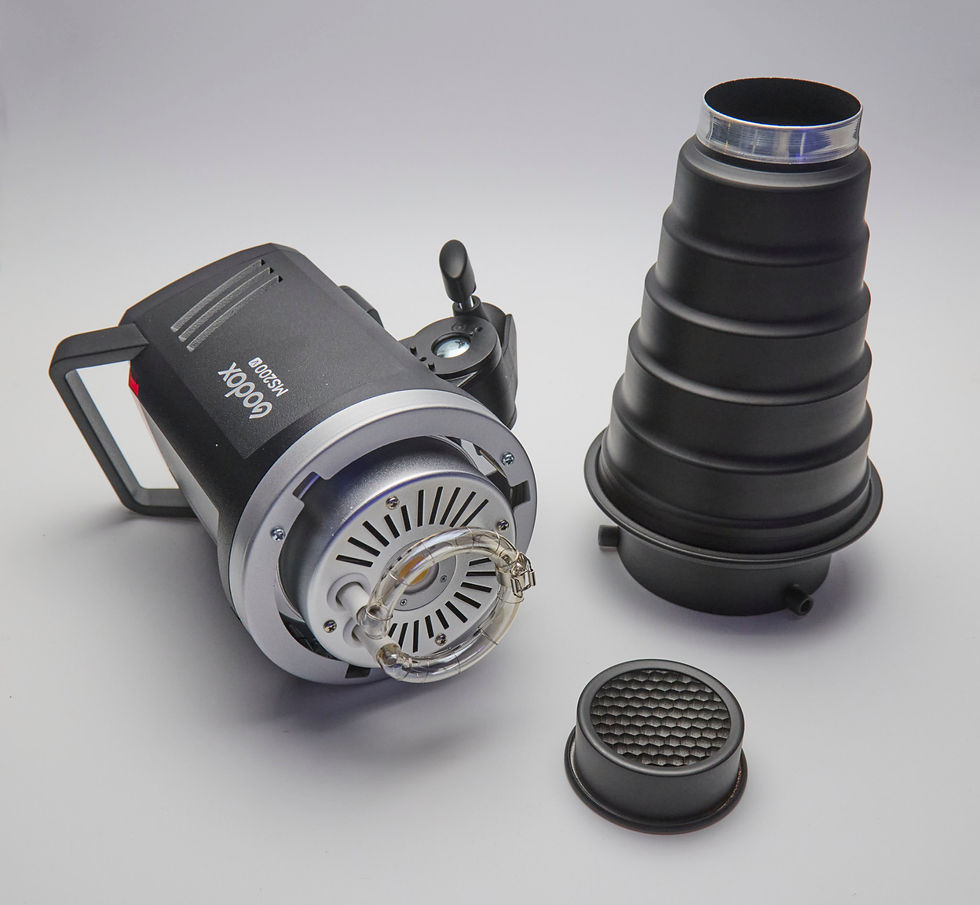
LED Studio Light
For all of these reasons, I prefer working with continuous light for iris photography. Above all, it gives me one thing back: control. In principle, there are two different approaches.
The first option is a classic studio LED combined with a snoot – an attachment that strongly narrows the light beam. Ideally, this is complemented by a honeycomb grid that suppresses lateral spill. This setup not only reduces the size of the light cone, but also allows very precise control over the size of the unavoidable reflection on the surface of the eye.

The major advantage of this solution is that it allows you to work calmly and deliberately. The light can be positioned at low brightness so that the reflection sits exactly where you want it – and you can see it before triggering the shutter. Test shots are extremely helpful here. Just as useful is having a computer or at least a large monitor within view, ideally positioned so it can be checked with a slight turn of the head, without getting up.
Working with continuous light instead of flash means giving up the motion-freezing effect of ultra-short flash durations. Camera shake therefore becomes a real concern – especially since the eye never stands perfectly still. To counter this, I use relatively short shutter speeds, around 1/640 second, and raise the ISO accordingly (for example ISO 1000 at f/4).
The fairly open aperture further reduces depth of field, but that is of secondary importance here, since I am deliberately working with focus stacking. At this stage, maximum depth of field in a single image is not the goal. What matters is a calm, repeatable shooting process.
LED Macro Light
The second approach to continuous lighting uses specialized LED macro lights with flexible gooseneck arms, ideally mounted directly on the camera. A well-known example is the Adaptalux system from a manufacturer in the UK. Comparable solutions from other brands are also available.
Regardless of the specific product, several characteristics are crucial. The individual light sources should be freely positionable, their diameter as small as possible, and their brightness independently adjustable – all the way down to complete shutoff. This fine level of control is extremely important in iris photography, since even minimal changes in lighting can have a major impact on reflections, contrast, and the perceived depth of iris structures.
These macro lights are less powerful than studio LEDs, but they are extremely precise and operate very close to the subject. They are particularly useful when reflections need to be placed deliberately and stray light must be rigorously eliminated.

Light Reflections
Light reflections are the declared enemy of iris photography. Anything that reflects in the eye has to be painstakingly removed later in post-processing. That costs time, nerves, and almost always comes at the expense of image quality. The simplest and best strategy is therefore to avoid reflections altogether.
A frequently suggested approach is the use of a polarizing filter. A good polarizer can indeed reduce bright reflections. The emphasis, however, is on “good.” Cheap filters do little here, and cross-polarization – placing polarizers on both the lens and the light source – did not work in my tests. Instead of reflection-free images, I got colorful interference patterns directly on the iris. Interesting, yes. Helpful, no.

A far better approach is to design the lighting from the outset so that reflections are minimized. The key factor here is the diameter of the light beam. The wider it is, the more of the immediate surroundings are illuminated – eyelids, eyelashes, skin – all of which inevitably reflect in the eye. These reflections can be removed later, but the effort increases exponentially. The best reflections are still the ones that never existed.
In addition to choosing the right light source, the beam can often be narrowed further using very simple means, such as a cardboard tube slipped over the LED light – essentially an improvised snoot. It may look unspectacular, but it works surprisingly well.
One often hears the recommendation to aim the light straight at the eye, at a 90-degree angle, so that the reflection falls into the black pupil. Technically, that is correct. From a visual standpoint, however, it is deeply unappealing. Anyone aiming to produce the most boring iris photographs possible will be well served by this approach. The true appeal of the iris lies not only in its color, but in its subtle relief of light and shadow. And that only emerges through directional side lighting. No shadows, no depth.
The opposite extreme would be pure side lighting, with the light coming entirely from the left (for the left eye) or from the right (for the right eye). The problem is that the eye is convex. The side of the iris facing away from the light remains dark. These areas can be selectively brightened later on the computer, but the result is far more convincing if some light already reaches the opposite side during capture.
For this reason, a steep lighting angle somewhere between side lighting and roughly 45 degrees has proven effective. This range invites experimentation – ideally at low light output and wide aperture, without worrying about depth of field, but with great consideration for the comfort of the subject. Compare the results directly on the computer, preferably together with the person being photographed. After all, the final image should not only be technically convincing, but also visually pleasing.
In this configuration, the unavoidable reflection usually ends up in the outer, mid region of the iris. There, it is easiest to remove later. While there are various software-based solutions for this, one particularly elegant trick avoids heavy retouching altogether.
The Two-Light Trick
This method uses two slim LED lights, for example on gooseneck arms. One is positioned to the left of the eye, the other to the right, both at similar angles. First, only the right-hand light is switched on and an image is taken, producing a reflection on the right side of the iris. Then the right light is switched off, the left light is switched on, and the shot is repeated with identical settings. This second image contains exactly those structural details that were washed out by the reflection in the first image. In post-processing, these details simply need to be layered over the reflection.
It is important that both shots are taken in close succession, so that the position of the eye remains as identical as possible. When done carefully, this method works surprisingly well – and in the end saves more work than it initially costs.
The Iris
The iris is not a flat, uniformly structured surface, but a complex, multilayered tissue with pronounced relief.
Most of it consists of the stroma – and this is exactly the tissue we are interested in photographing. It is made up of collagen fibers that, in many people, appear as fine, clearly defined lines, often arranged like the spokes of a wheel. On the surface of the stroma lie the structures that give the iris its characteristic appearance: fibers, crypts, and fine micro-fissures, which together create its three-dimensional relief.

Embedded within the stroma are also the muscles that control pupil size. For photography, their function is less important than their effect on local tissue tension – and thus on the relief and depth of individual structures.
Beneath the stroma lies the heavily pigmented pigment epithelium. It acts like a light-tight curtain, preventing light from passing through the iris into the interior of the eye. In other words, it ensures that light enters the eye only through the pupil and the lens. Especially in light-colored, blue irises, whose stroma contains very little pigment, this underlying pigment epithelium can influence the visual appearance, since the view penetrates optically deeper into the tissue.

Irises differ not only in color, but also fundamentally in their structural makeup. Some display clearly defined, sharply reproducible fiber structures with hard edges. Others appear soft, diffuse, or “cottony” – not because the photograph is out of focus, but because the tissue itself lacks sharply defined contours. This characteristic is particularly common in gray and some blue eyes and sets a natural limit to photographic sharpness.
How Eye Color Is Created
Many people believe that human eye color is caused by different pigments – blue, green, or brown. In reality, this is not the case. Only a single pigment plays a relevant role: melanin. And melanin is always brown – regardless of whether an iris appears blue, green, or dark brown.

What matters is not the type of pigment, but its quantity and its spatial distribution within the iris tissue. If an iris contains a large amount of melanin, most of the incoming light is absorbed. The iris then appears dark brown or nearly black.
If, on the other hand, very little melanin is present, light penetrates deeper into the iris tissue (the stroma). There it is scattered by fine structures. This scattering favors short-wavelength light, causing the iris to appear blue. Blue eye color is therefore not a pigment color, but a purely physical scattering effect – similar to the way the blue color of the sky is created (which gives the term “sky-blue eyes” a whole new meaning).
With a medium amount of melanin, light scattering and pigment absorption overlap. The result is green, olive, or yellow-green irises. As melanin content increases further, this mixed color gradually shifts toward brown.
In short: A lot of melanin makes eyes dark. Little melanin produces blue through light scattering. Intermediate amounts result in green.
Blue and Green Eyes – Photographic Consequences
Blue, gray, and many green irises therefore contain relatively little melanin. This allows light to penetrate deep into the iris tissue – and the lens effectively “looks” deeper into the structure as well. In this case, the iris is not a clearly defined surface, but a semi-transparent volume.

In addition, the fibers of such irises are often soft, diffuse, or “cottony” in structure. They scatter light strongly, have only weakly defined edges, and sometimes appear slightly translucent. These characteristics impose natural limits on photographic sharpness. Not every blur is a technical flaw – often the subject itself simply lacks sharply reproducible contours.
At the same time, numerous crypts and fissures form between these fibers, making blue and green irises visually complex and fascinating despite their limited edge sharpness.
Brown Eyes – Photographic Consequences
Brown irises contain significantly more melanin. Their fibers are more heavily pigmented, show clearer contours, and often form a relatively dense, continuous layer. Light penetrates less deeply into the tissue, and the iris appears optically flatter.
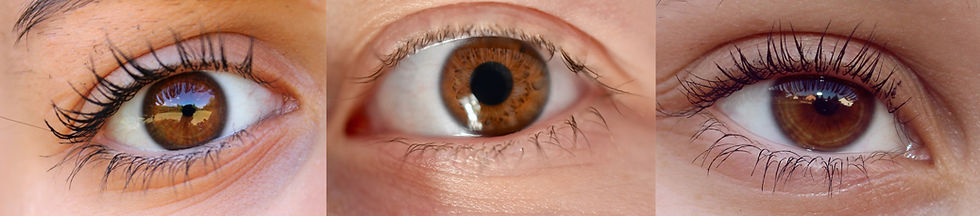
As a result, brown irises are often easier to capture sharply than light-colored irises and usually require less effective depth of field. At the same time, they may appear more structurally uniform, since pronounced crypts and fissures are less common. This can make them visually less spectacular in some cases – although, as always, there are plenty of exceptions.
Depth of Field
The thickness of the human iris varies slightly and typically lies between about 0.5 and 1.5 millimeters. For a successful photograph, however, it is not strictly necessary to include this entire depth within the depth of field. The rear portion of the iris tissue is the pigment epithelium – a heavily pigmented, light-tight layer – and it is optically inaccessible to light.

Ultimately, two factors determine image quality: sufficient depth of field and minimal diffraction blur. Unfortunately, these two work directly against each other. Stopping down the lens increases depth of field, but at the same time it also increases diffraction. Every iris photograph is therefore a compromise between these two physical effects.
It is often claimed that, in full-frame photography, aperture f/11 is completely unproblematic with regard to diffraction. This statement falls short. Diffraction blur occurs when light is bent at a small aperture opening and fine details can no longer be rendered clearly. How early this effect becomes visible depends largely on the pixel size of the sensor.
Cameras with larger pixels show diffraction effects only at higher f-numbers. Cameras with very small pixels reveal the loss of sharpness earlier – not because they are inferior, but because they are capable of resolving much finer detail in the first place.
In practical terms, this means that a camera with large pixels can still deliver usable sharpness at higher f-numbers (and smaller apertures). High-resolution cameras with small pixels, on the other hand, require wider apertures if maximum detail is to be preserved.
One crucial point is often overlooked: in macro photography, it is not the set aperture that matters, but the effective aperture.
The Effective Aperture
At magnifications of 1:1 and beyond, the way light travels through the lens changes fundamentally. When focusing at very short distances, the distance between the lens and the sensor increases. As a result, the light is spread over a larger area, and the effective f-number increases.
The effective aperture is given by:
Neff = N × (1 + m)
Here, N is the set aperture and m is the magnification.
An aperture of f/8 thus becomes an effective f/16 at 1:1, and even f/24 at 2:1. As a result, both light loss and diffraction increase significantly – often without being noticed. This is why macro photography is usually done with relatively wide apertures, not out of convenience, but to avoid unnecessary diffraction. The required depth of field cannot be increased arbitrarily using classical methods – and this is precisely where iris photography has so far run into a physical limit.
This is one of the most common sources of error. Either one works with too little depth of field out of fear of diffraction, or one stops down too far and quietly loses fine detail to diffraction blur.
To make these relationships more tangible, the following sections list depth-of-field values for various magnifications and effective apertures. The color coding is deliberate:
no visible diffraction
clearly soft, but often acceptable
distinct loss of detail due to diffraction
Depth of Field – Full Frame
Magnification 1:1
Camera Canon R5 II, lens Canon MP-E 65mm
Aperture f/4 (effective f/8), depth of field approx 0,48 mm
Aperture f/8 (effective f/16), depth of field approx. 0.96 mm
Aperture f/11 (effective f/22), depth of field approx. 1.32 mm
Aperture f/16 (effective f/32), depth of field approx. 1.86 mm
Magnification 1.4:1
Camera Canon R5 II, lens Canon RF 100mm Macro f/2.8 L
Aperture f/4 (effective f/9.6), depth of field approx. 0.29 mm
Aperture f/5.6 (effective f/13.4), depth of field approx. 0.40 mm
Aperture f/8 (effective f/19.2), depth of field approx. 0.57 mm
Aperture f/16 (effective f/38.4), depth of field approx. 1.14 mm
Magnification 2:1
Camera Canon R5 II, lens Canon MP-E 65mm
Aperture f/4 (effective f/12), depth of field approx. 0.18 mm
Aperture f/5.6 (effective f/16.8), depth of field approx. 0.25 mm
Aperture f/8 (effective f/24), depth of field approx. 0.35 mm
Aperture f/16 (effective f/48), depth of field approx. 0.70 mm
Magnification 2:1, Film Scanner Lens
Camera Canon R5 II, lens Minolta 5400, focal length 39 mm
Aperture f/3.7 (effective f/11.1), depth of field approx. 0.16 mm
On full-frame cameras with high-resolution sensors (R5 / R5 II class), diffraction becomes visible at an effective aperture of around f/11, clearly noticeable at f/16, and dominant by f/22. In macro photography, only the effective aperture matters – not the value set on the lens.

As a reminder, the depth of the human iris lies between roughly 0.5 and 1.5 millimeters, depending on the individual eye. If the eye is not perfectly aligned with the camera, the required depth of field increases even further.
If we take the maximum depth of field achievable without visible diffraction (the green values) as our reference, one thing becomes clear: only very shallow irises can be captured fully sharp in a single exposure. In practice, this mainly applies to certain brown irises with dense pigmentation and few deep crypts, where light does not need to penetrate far into the tissue.
This explains why some eyes can be photographed with apparent ease, while others remain persistently soft despite identical equipment and technique. As soon as one tries to solve this problem by stopping down further, nominal depth of field increases – but fine detail is inevitably lost to diffraction blur.
Depth of Field and Medium Format
A seemingly obvious idea is to use a medium-format sensor in order to capture the iris with more pixels and allow for greater enlargement. When it comes to the depth-of-field problem, however, this helps very little.
The underlying formulas do not change in medium format. Because the permissible circle of confusion is larger, depth of field is actually reduced at the same magnification. In so-called “small” medium format (44 × 33 mm), depth of field is roughly 25 percent smaller than in full-frame.
Example:Magnification 1:1Fuji GFX 50S II, 120 mm macroAperture f/8 (effective f/16)→ depth of field approx. 0.74 mm
Here too, depth of field is usually sufficient for only part of the iris – not for its full three-dimensional structure.
All things considered, classic single-shot techniques deliver only limited results. Focal lengths between roughly 65 and 100 mm and effective apertures in the range of f/4 to f/8 usually represent the best compromise. Any magnification beyond 1:1 further reduces depth of field, and stopping down more inevitably leads to diffraction – especially with high-resolution cameras that use small pixels.
This is the fundamental limitation of traditional iris photography: with classical techniques, the spatial structure of an iris with very thick tissue (stroma) can be captured either sharply or completely – but not both at the same time.
And this is exactly where focus stacking comes into play.
Practical Workflow
A stable head position is essential for iris photography. A height-adjustable chin rest combined with a forehead support has proven very effective. Camera and lighting should be fully set up before the subject takes position. Making adjustments only after the light is already on unnecessarily strains the eye and should be avoided.

The lighting should be dimmable. Very low light levels are sufficient for focusing and place minimal strain on the eye. Only after focus has been set precisely is the light briefly increased – always after warning the subject.
I position the autofocus point on the iris just below the pupil and then switch to magnified live view. This allows the lower part of the iris to be evaluated at full frame.
When using in-camera focus stacking via autofocus, this position serves as the starting point for the sequence (my settings: series size 3 to 5 frames, step size 3 or 4 out of 10).
When working manually, the first image is taken at this focus point. The focus plane is then moved forward in very small increments using a linear focusing rail, several images are captured at each position, and the process continues – always under visual control on a large monitor connected directly to the camera.

Focus Stacking in Iris Photography
Focus stacking is generally considered a technique for static subjects. The human iris, however, constantly exhibits tiny involuntary movements, even under maximum concentration. At magnifications of 1:1 and beyond, these movements become a serious problem. Traditional stacks with many frames almost inevitably lead to blur, artifacts, or double contours.
For this reason, focus stacking in iris photography was long considered practically unmanageable – especially when combined with high-resolution macro lenses, film scanner lenses, or even microscope optics.
The real breakthrough only becomes possible through extremely fast image sequences made possible by modern cameras.
The Three-Image Approach
The starting point is a single image with limited depth of field, for example about 0.96 mm at a magnification of 1:1. For many irises, this is simply not enough, especially when the iris plane is not perfectly parallel to the sensor.
Instead of capturing many individual images and selecting the best one, my approach deliberately limits the sequence to just three images (or three to five). With in-camera focus bracketing, the starting point, step size, and number of frames are defined – the endpoint results automatically. If too many images are captured, a significant portion of them lies well beyond the relevant focus plane and contributes nothing to the final result. On the contrary, such frames can actually degrade the stacking result. A 20-frame sequence also takes more time.
The goal is therefore to keep the capture phase as short as possible. With three to five images, the entire sequence is completed in a tiny fraction of a second. During this time – if handled carefully – only minimal eye movements are to be expected. Not every sequence will succeed, but by shooting several short sequences in a row, usable results are very likely.

Internal and External Focus Stacking
In my workflow, the camera’s internal stacking is primarily used as a preselection tool. Of course, the internally stacked image can be used as a final result, but in my experience, dedicated focus-stacking software such as Helicon Focus often produces noticeably better outcomes.
That said, internal stacking allows immediate evaluation of which sequences are usable. The real quality work then takes place in the stacking software.
Comparative tests with cameras only a few years older – which required longer pauses between individual frames – did not yield a single convincing result. In those time windows, the inevitable micro-movements of the eye are already large enough to prevent clean stacking. What matters most is therefore not the presence of an internal stacking function, but the speed of the entire sequence.
As of early 2025, the selection of full-frame cameras capable of internal focus stacking with automatic compositing remains very limited. At that time, only three models supported it: Canon R1, R3, and R5 Mark II.

Canon R7 and R10 also offer this function, but use APS-C sensors. These provide fewer reserves for strong enlargement, such as large-format prints, although they do offer slightly greater depth of field. Similar considerations apply to cameras from the Olympus OM-D series with Micro Four Thirds sensors. These cameras are also capable of internal focus stacking and benefit from greater nominal depth of field.
However, these advantages come with system-related drawbacks. Smaller sensors require smaller effective apertures at comparable magnifications, causing diffraction to appear earlier, and they offer lower light sensitivity. For applications where maximum detail resolution and large output sizes are the goal, these benefits quickly lose their weight. As so often, no system is inherently superior – what matters is consistently adapting the method to the underlying physical limits.
Iris Photography and Data Protection
Data protection again? Unfortunately, yes – but this time for a good reason. As iris photography becomes more popular, an issue emerges that really shouldn’t be brushed aside.
The iris is not a decorative pattern. It is a unique biometric identifier, comparable to a fingerprint. In some countries, it is already used for identification, for example at border controls or in security-related access systems. High-resolution iris photographs are therefore more than just pretty images. At least in theory, they could be misused if identification systems are unable to reliably distinguish between real eyes and reproduced images.
Things become particularly problematic when such photos are shared publicly without modification. Anyone who posts iris images online and can clearly be identified as the person they belong to is revealing something highly personal. That is roughly as sensible as publishing a well-lit photo of your own fingerprint.

Many people have their irises professionally photographed and enthusiastically share the results on social media – often without realizing that these images represent biometric data. Hence this brief reminder: irises are not harmless motifs. If iris photographs are shown publicly and can be linked to a specific person, small structural details should be subtly altered. This is easy to do in post-processing and virtually invisible in the final image.
Iris photography is fascinating, visually striking, and technically demanding. It also requires a minimum level of responsibility. Anyone creating or publishing iris images should pause for a moment and consider where those images will end up – and whether a small intervention during post-processing might be the wiser choice.
Post-Processing
To conclude, here is a brief and strongly simplified step-by-step guide for creating iris images with a simulated collision on a black background, using Affinity Photo as an example:


Step 1: Remove reflections (LED light, eyelashes, and other unwanted reflections).
Step 2: Create a circular selection(Affinity Photo: Selection Tool → Elliptical Selection).
Step 3: Define edge softness(Affinity Photo: Select → Feather, enter a value, for example 70).
Step 4: Copy the content of the circular selection to the clipboard(Affinity Photo: Command/C), or save it as a .png or .afphoto file to preserve transparency.
Step 5: Create a new file, for example A3 landscape format.
Step 6: Paste the circular selection into the new file(Affinity Photo: Command/V).
Step 7: Create a black background layer and move it behind the iris layer.
Step 8: Position the irises as desired.
Step 9: Select the brush tool and use an appropriate brush tip to create collision fragments.(Affinity Photo: brushes for generating small fragments are usually available only as add-ons, for example from “Dreamphotography”.)
Conclusion
There are many ways to achieve convincing iris photographs. Many experienced iris photographers produce impressive results using single images – especially when the iris is relatively flat and light does not penetrate deeply into the tissue. And anyone who needs a bit more depth of field but does not plan large-format prints may be perfectly well served by smaller sensors. That works too – no magic required.
The approach presented here is therefore not meant to replace established methods or convert anyone. It is aimed specifically at situations where classical techniques reach their limits: when light penetrates deeply into the stroma, the iris becomes spatially complex, and more depth of field is required than camera and lens can provide.
In such cases, a small dive into the photographic bag of tricks can help. Focus stacking is neither a cure-all nor a new standard – it is simply an additional tool. For some, it is unnecessary. For others, it opens exactly the door that was previously closed: toward sharper, better-controlled, and above all reproducible results.
Or, to put it briefly: You can do iris photography perfectly well without focus stacking. It’s just reassuring to know that you don’t always have to.


Kommentare